
Reports, Resources, Documents
& Links

This material is compiled by Katherine Short, Principal and Director of F.L.O.W. Collaborative Ltd. Most of it she has conceptualised, led or significantly contributed to.
Some pieces are included as pieces of work that Katherine considers important to be aware of.
Transitioning to a Regenerative Blue Economy
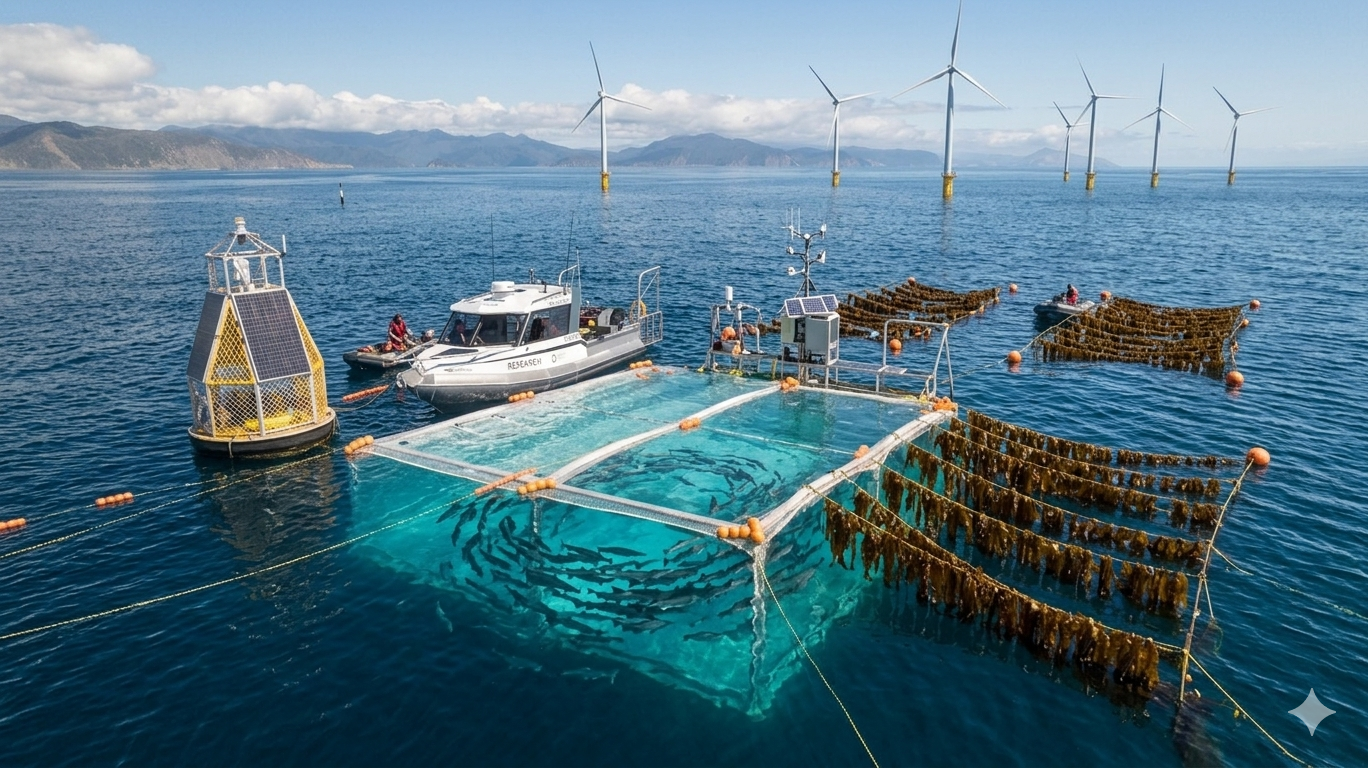
An entirely imaginary Blue Economy Zone including integrated multi-trophic aquaculture and offshore wind. Imagery of an adapted version of the Plant and Food Research Mobile Aquaculture Production System used with permission. Gemini AI generated. 17.04.26.
Prepared by F.L.O.W. Collaborative’s Katherine Short, this document sets out a concise, action‑focused framework for growing a regenerative blue economy in Aotearoa New Zealand. It distils insights from national blue economy research and twenty-five years of practical experience, working with the seafood sector and in marine conservation and ocean governance. It notes eight practical priorities that connect ocean health, climate resilience, regional prosperity, and Māori aspirations.
Written for political parties, government agencies, investors and financiers, iwi, industry leaders and ocean advocates, it aims to stabilise New Zealand’s blue economy direction and reduce policy uncertainty. The framework is offered as a constructive contribution to the 2026 pre‑election and post‑election debate, highlighting how a deliberate, well‑governed blue economy can unlock jobs, investment and resilience while restoring marine ecosystems.
Please do get in touch if you’d like to explore how we can Optimise the Many Values in our Emerging Blue Economy overall and/or how F.L.O.W. Collaborative Ltd can support your business to go further faster to be more sustainable and contribute to regenerating marine ecosystems.
The version available here is fully referenced.
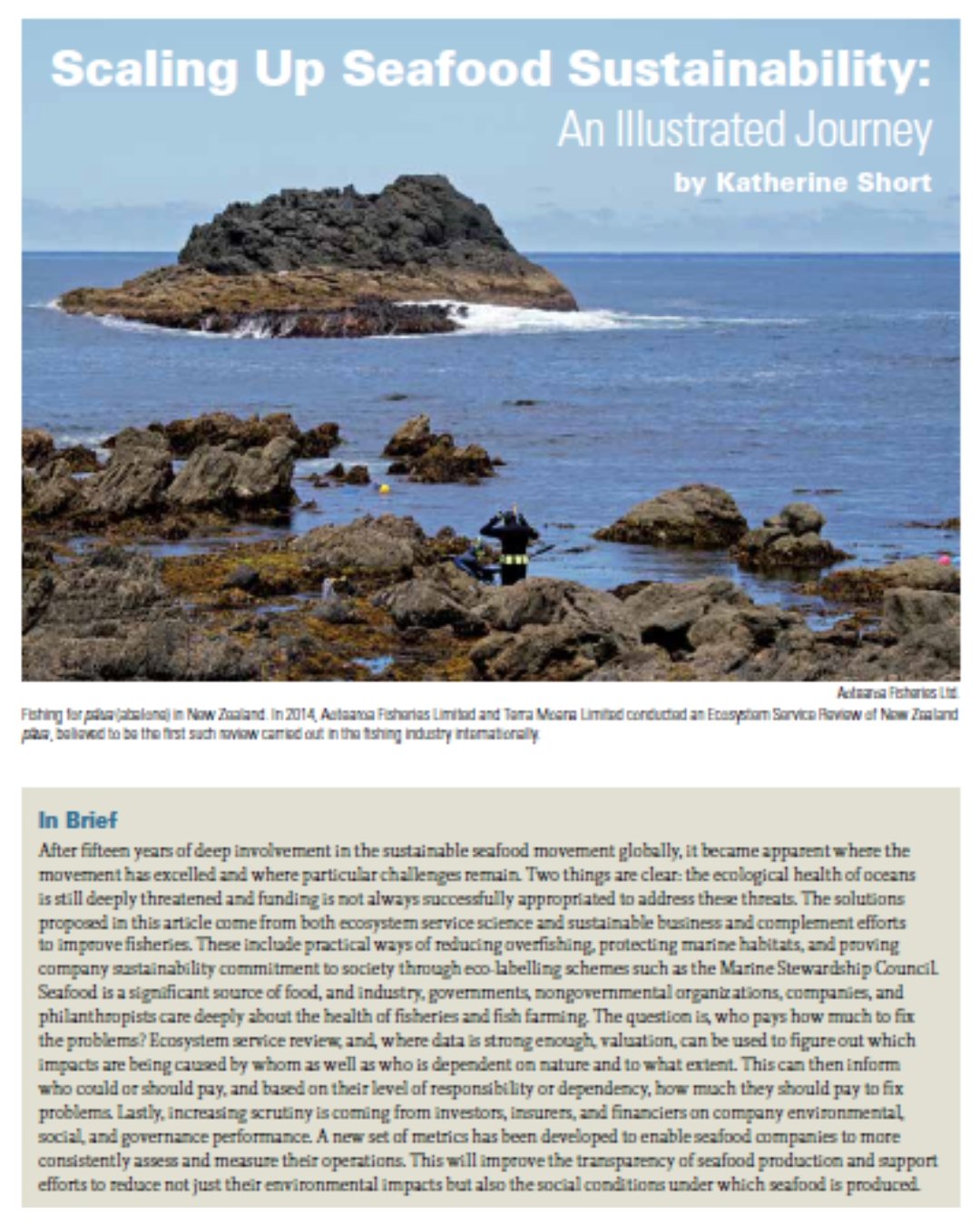
Scaling up Sustainable Seafood
This is a published journal paper about natural capital and ecosystem-services applied to seafood. It documents Katherine’s Masters in Conservation Science (Imperial College) where she dove ‘beyond ecolabelling’ to research corporate accountability. It foreshadows her work with Terra Moana, Moana New Zealand and the Sustainable Seas Science Challenge on blue economy, and climate risk and seafood.
Reconciling Ocean Health
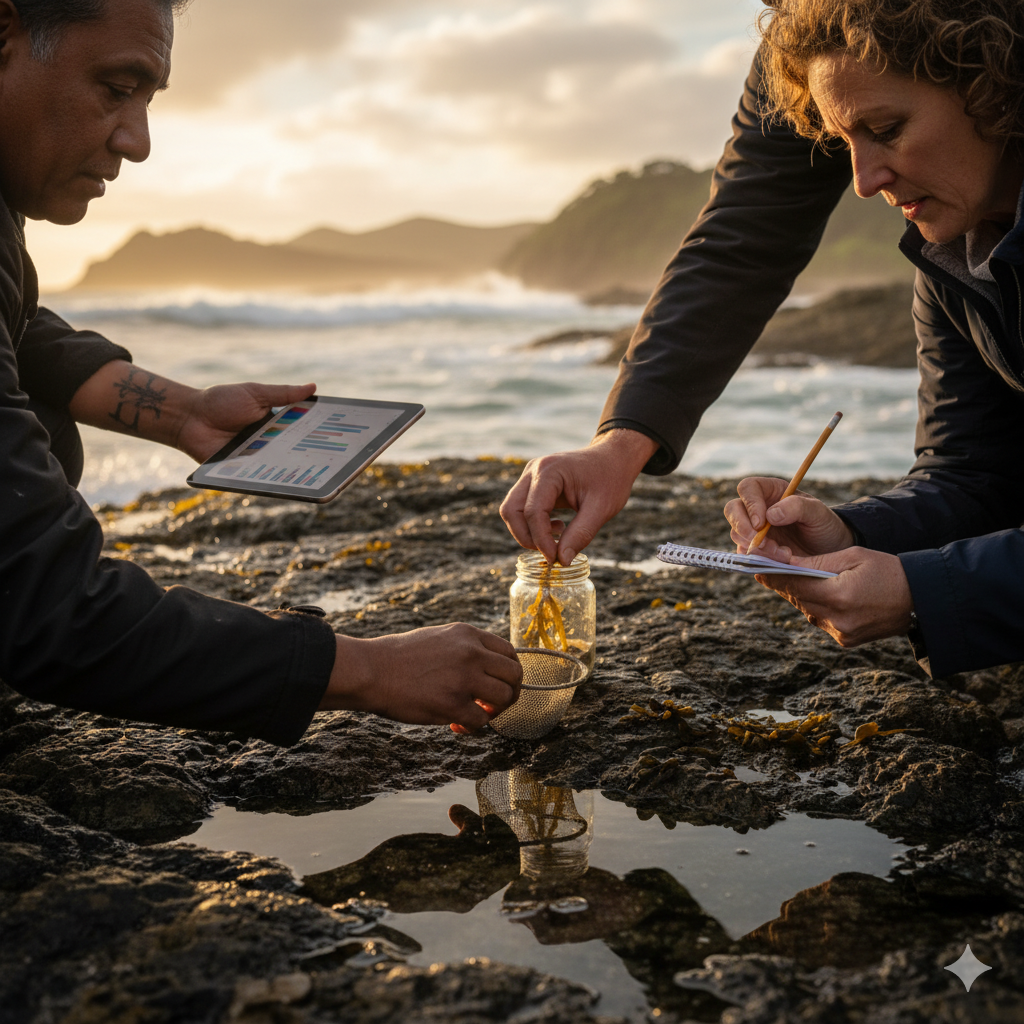
Written mostly by Katherine when she was co-Director of Terra Moana 2011-2014, and continuously updated as the Māori ocean governance arena develops, this paper seeks to describe a process whereby a Kaupapa Māori approach could be taken to designing better care of marine areas nationally.
The Blue Cradle Tiaki Moana Kaupapa, and meeting in French Polynesia in March 2025 regarding indigenous foundations for OECMs (Other Effective area-based Conservation Measures) aligns with this vision. Katherine Short was lead author on the Tiaki Moana report, and which was presented at the UN Ocean Conference in France, June 2025. Scroll down to the Indigenous Perspectives section below to find the link to the Tiaki Moana report.
Ocean Literacy
With support from Plant and Food Research who Katherine was on contract to for five years, this reports on a workshop exploring the need for a nationally coherent approach to ocean literacy that was run at the 2021 Tauranga New Zealand Marine Sciences Society Conference.
Katherine Short has a deep commitment to fostering a regenerative blue economy. This comes from her deep background growing up in a maritime family, working in the WWF Market Transformation Initiative, growing the sustainable seafood movement globally, and WWFs leadership in shaping the blue economy gives her a solid foundation as a blue economy specialist. Whilst partner in Terra Moana Katherine led several important blue economy pieces of work for the Sustainable Seas Science Challenge:
Climate Risk & Seafood
Blue Economy
Given Katherine’s Masters research, applied development of marine (and seafood/fisheries) ecosystem services, and engagement with the Sustainable Seas Science Challenge Terra Moana (Katherine led) was invited (by Dr Judi Hewitt of the Challenge Senior Leadership team) to conceptualise and deliver this programme of work. It was then co-developed with partners including Tony Craig, Dr Hewitt Dean Spicer (Head Sustainable Finance) from ANZ Bank, and the Pāua Industry Council.
Three-part report on the PAU2 pāua fishery, environmental threats, legal and financial considerations, and recommendations
Summary of Findings (Upholding the Value of Pāua Quota)
Pāua quota valuation bio-economic model and operation manual
Appendices (climate vulnerability assessment, natural hazards for PAU2, diver survey results, project survey form, PAU2 proposed resilience plan, and PAU2 resilience briefing)
Other: Aotearoa Circle Seafood Sector Climate Adaptation Strategy and Integrated (Seafood) Scenarios.
Indigenous Perspectives, Te Ao Māori, Māori Ocean Governance, Māori Marine Economy, Tikanga, Mauri
With her long-standing multi-cultural upbringing and professional background, her personal spiritual relationship to nature and the earth, to the Atua (deity) Papatūānuku (earth mother), and her intentional upholding of The Treaty of Waitangi, Katherine Short is committed to supporting Māori, and indigenous-led marine management and care. The following are some important papers and work that Katherine has either contributed to or recommends.
Short, K., Hikuroa, D., Nikitine, J., & Rowland, S. (Eds.). (2025). Tiaki Moana: Pacific wisdom and community action for ocean protection. Blue Cradle Foundation.
Hikuroa, D., Nikitine, J., Burkhardt, H., Moeahu, K., Short, K., Berger, M., Clarkin, J., van Dijken, S., & Broan, K. (2025, August). Aotearoa New Zealand: A laboratory for future marine conservation. Marine Policy, 178, 106711.
Sustainable Seas Science Challenge Quota Tikanga (ICP/Maru Samuels/Irene KereamaRoyal) .
Māori Ocean Governance Scenarios Project (Beth Tupara-Katene).
~600pg report that Robert Joseph and others did on Māori and Ecosystem-based Management/ocean governance etc in the first phase of the challenge.
Jason Mika re. Māori Blue Economy
Lara Taylor, Dan Hikuroa and Desna Whanga-Schollum re. Kaitiakitanga and EBM and the entire Te Ao Māori workstream in Sustainable Seas.
www.marineculturalhealth.co.nz , www.mauriometer.org and www.mauricompass.com initiatives.
That Mauri is included in the NZ-UK Free Trade Agreement (Ch 22.9).
The Sustainable Seas Science Challenge Synthesis and Full research repositories.
Moana New Zealand
photo credit: FloMo Precision Seafood Harvest)
Through a long-standing relationship with The David and Lucile Packard Foundation Marine Programme, Katherine Short received a grant to develop her marine natural capital research in practice through working with Moana New Zealand (legally known as Aotearoa Fisheries Limited (AFL)). AFL was formed in 2004 as a result of the 1992 Treaty of Waitangi Fisheries Settlement between The Crown (Government of New Zealand) and Iwi/Māori.
Tony Craig had been an employee and adviser to AFL/Moana New Zealand for many years and Tony and Katherine formed Terra Moana to become strategic and operational sustainability advisers to Moana New Zealand, along with a range of other projects.
Terra Moana contract work for, and with Moana New Zealand:
Pāua as taonga (Ecosystem Service Review)
Whangaroa Harbour Catchment Study (Natural Capital)
A review of Moana New Zealand’s efforts to reduce seabed contact by fishers engaged in bottom trawl, Danish seining, and bottom longline fishing in New Zealand (Short version modified from 100 pp commercial in confidence report to Moana New Zealand by Terra Moana and Smart Fishing (Dr Steve Eayrs).
Marine Natural Capital & Seafood
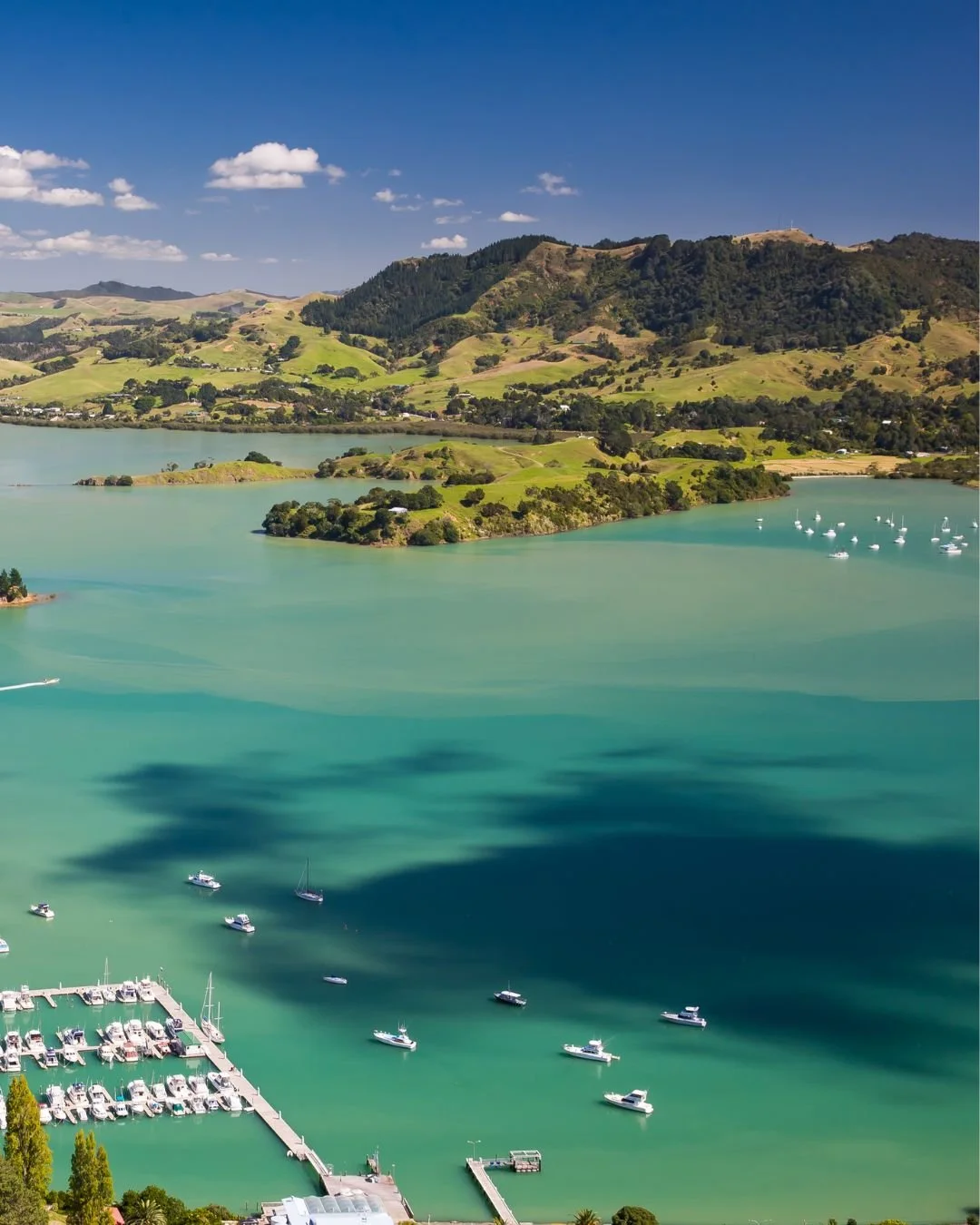
As a strategist, ecologist and having spent over a decade fostering the sustainable seafood movement globally, Katherine could see that seafood ecolabel standards and certification was only part of the picture about corporate responsibility in seafood. Her sponsored Masters studies at Imperial College London dove beyond ecolabelling into marine natural capital and ecosystem services. Through a start-up grant from the David and Lucile Packard Foundation this was then applied in practice working with Moana New Zealand. Two ecosystem service reviews were conducted.
Scaling up seafood sustainability, an illustrated journey. Solutions Journal. 2016. This published my Masters research which was explored in practice with Aotearoa Fisheries Ltd (now Moana New Zealand).
Through the Sustainable Business Council (SBC) Natural Resources Sector project Capturing the Value of Nature in Decision Making (2014) Pāua as Taonga was produced. This is the public report of the New Zealand Pilot of the Corporate Ecosystem Services Review (Aotearoa Fisheries Ltd, 2014) (CESR, World Resources Institute), SBC pilot with guidance from Dr Suzie Greenhalgh of Manaaki Whenua. It was then extended to provide a financial valuation of the impact of sedimentation upon pāua quota value (available on request).
Terra Moana Aotearoa Fisheries Limited (Moana New Zealand) Natural Resources Sector Project “Capturing the Value of Nature in Decision Making” Business Case Study for the Sustainable Business Council and Department of Conservation. 2014. This built upon the Pāua as Taonga and CESV Pilot as a financial valuation and is available upon request.
Whangaroa Harbour and Catchment Study. 2022. This was the second ecosystem services study Terra Moana did with Moana New Zealand. The Auckland Institute for Marine Sciences became involved towards the end.
This work led to Katherine’s Masters being published in The Solutions Journal: “Scaling Up Sustainable Seafood”. It is likely that this work was the first corporate ecosystem services review of a commercial seafood globally.
New Zealand Ocean Policy
Since 1998 when the ‘SeaViews’ Conference was held by the Environment and Conservation Organisations of New Zealand, there have been at least a further 12 reviews about New Zealand ocean governance, management, legal and policy arrangements including by the Sustainable Seas Science Challenge, Environmental Defence Society, the McGuinness Institute, Michael McGinnis, the Prime Minister’s Chief Science Adviser.
EDS Oceans Reform Final Report, Raewyn Peart, Environmental Defence Society 2025. Report on NZ oceans reform: strategy, planning, MPAs, recommendations.
Tangaroa Ararau: Te Tiriti o Waitangi, Tikanga Maori, and Marine Environment, Sustainable Seas NSC, 2024. Literature review on integrating Maori frameworks in marine management.
He Ara ki Tua: Marine Governance Models Report, Sustainable Seas NSC, 2024. Governance models centered on tikanga Māori, Te Tiriti, anticipatory governance.
National Party - Plan Blueprint for a Better Environment, National Party NZ, 2023. Policy plan/blueprint for NZ environment.
Lever Room Ocean Roadmap Discussion Doc August 2023, Rebecca Mills, The Lever Room Research, 2023. Ocean Roadmap for NZ; healthy ocean and sustainable economy.
Green Party Marine Policy 2022-2025, Green Party of Aotearoa NZ, 2022. Greens Marine Policy for 2022-2025.
The Future of Commercial Fishing in Aotearoa New Zealand, Office of Prime Minister’s Chief Science Advisor, 2021. Full commercial fisheries report, assessment of NZ stocks.
Reconciling Ocean Health, Katherine Short & Tony Craig (F.L.O.W Collaborative), 2018. Concept to reconcile world views for NZ marine health.
Ocean Management in New Zealand Findings (WP201501), James Tremlett, McGuinness Institute, 2015. Structured discussion, recommendations, management frameworks.
Ocean Governance: The New Zealand Dimension Full Report, Institute of Policy Studies, Victoria University, 2012. Full technical report on NZ ocean governance systems.
Oceans Policy – Feedback from Stakeholders (March–April 2003), NZ Government, 2003. Stage-two papers for NZ ocean policy consultations.
New Zealand’s Oceans Policy (2003), Foster (journal manager), 2003. Marine management journal article.
Seaviews, Environment and Conservation Organisations of New Zealand, 1998. Conference Papers.
Other
The work The Aotearoa Circle has done to understand the risks to seafood production from climate change, and potential adaptation pathways resulted in important Integrated Scenarios understandings.
Review of mitigation techniques to reduce benthic impacts of trawling (2019). Major report funded by the Department of Conservation that Katherine Short and Dr Steve Eayrs wrote. It led to Dr Eayrs, a global trawl impacts mitigation expert being hired by Moana New Zealand as part of their harvest footprint project. See 3& 8 above under Moana New Zealand. That work is shepherded by Tony Craig of Terra Moana.
The Lever Room Ocean Roadmap (2023) – This proposes the need for an Ocean Institute.
The need for a national and collaborative approach for Blue Finance, written by Katherine Short and James Nikitine of Blue Cradle Foundation for World Ocean Day. (2023)
Harvesting Value from Satellite Data (2023) – this is a crucial paper shaping the use of remote sensing in New Zealand which is so critical for marine ecosystem health monitoring e.g. marine flora/blue carbon habitats.
WWF
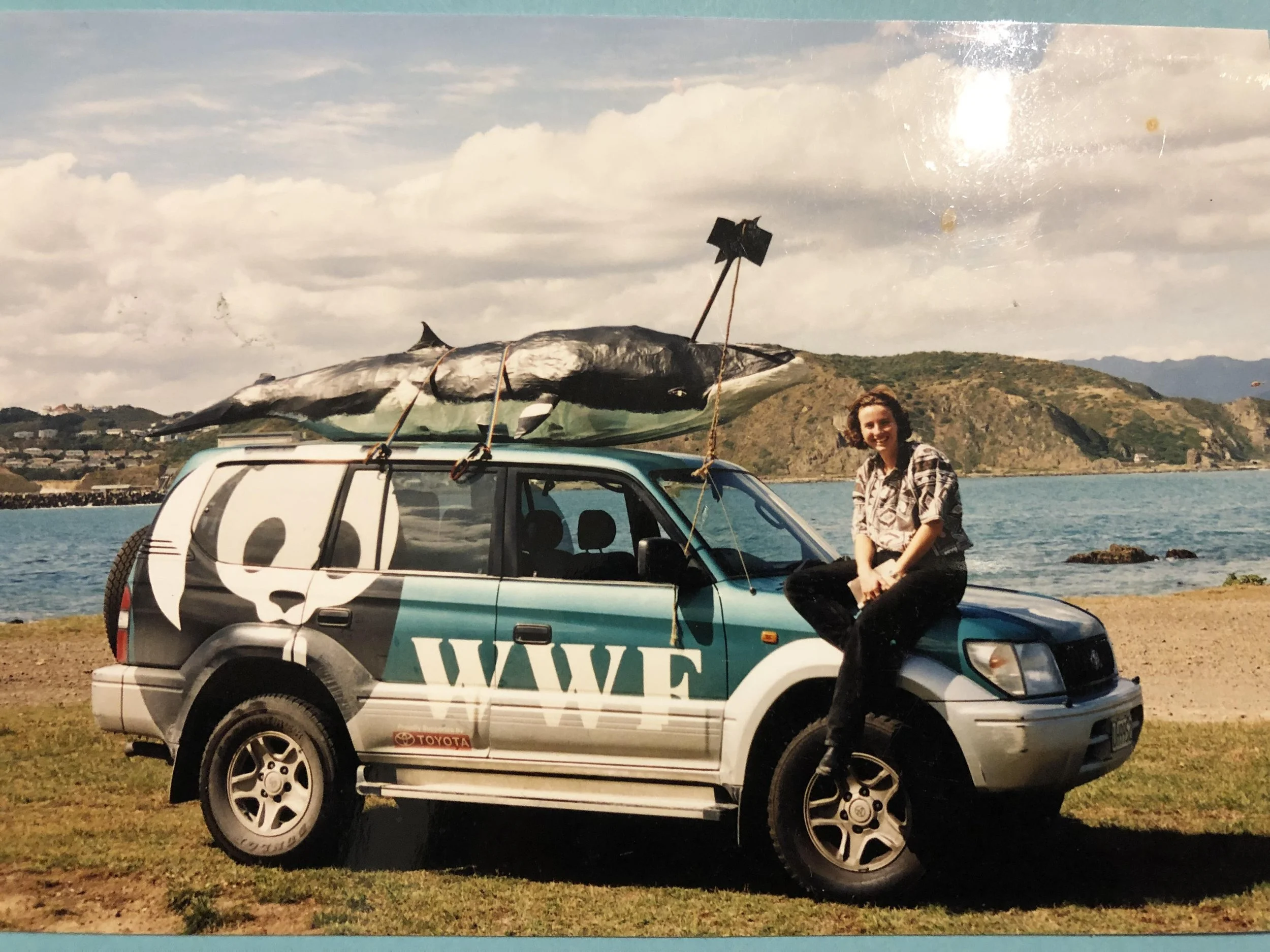
The following major WWF reports and papers were all grey literature that I conceptualised and brought to fruition (in the greater part for all leading the fundraising, team assembly, project management and being either lead or co-author).
Banks R, Short K, Tuqiri S 2012. WWF South Pacific Programme. South West Pacific Longline Caught Albacore: Going, Going, Gone? WWF Policy Briefing to WCPFC-8.
Short K 2012. South to South, Internal Peer Review of the Coastal East Africa and Coral Triangle Initiative Fisheries Strategies. WWF Coral Triangle and Coastal East Africa Initiatives.
Grieve C, Short K 2007. Implementation of Ecosystem-Based Management in Marine Capture Fisheries. Case Studies from WWF’s Marine Ecoregions. WWF International.
Lack M, Short K, Willock A 2003. Managing risk and uncertainty in deep-sea fisheries: lessons from Orange Roughy.
Ward T, Tarte D, Hegerl E, Short K 2002. Ecosystem-Based Management of Marine Capture Fisheries: Full Report. WWF Australia: 80 pp.
Ward T, Tarte D, Hegerl E, Short K 2002. Ecosystem-Based Management of Marine Capture Fisheries: Summary. WWF Australia: 6 pp.
WWF continues to develop leading analyses, benchmarking reviews and other material to drive better marine management outcomes e.g. seafood and banking and the blue economy. Important new Ocean Markets Blue Economy material is available here.
Katherine’s Publishing
In addition to the reports listed above.
Peer-reviewed journal articles
Short K 2015. Scaling up seafood sustainability, an illustrated journey. Solutions 6: 52–59.
Bladon AJ, Short K, M Mohammed EY, Milner-Gulland EJ 2014. Payments for ecosystem services in developing world fisheries management. Fish and Fisheries 17(3): 839–859.
Pitcher T, Kalikoski D, Short K, Varkey D, Ganapathiraju P 2009. An evaluation of progress in implementing ecosystem-based management of fisheries in 33 countries. Marine Policy 33(2): 223–232.
Pitcher TJ, Kalikoski D, Pramod G, Short K 2009. Not honouring the code. Nature 457: 658–659.
Tudela S, Short K 2005. Paradigm shifts, gaps, inertia, and political agendas in ecosystem-based fisheries management. Marine Ecology Progress Series 300: 241–296
Peer-reviewed books, book chapters, books edited
Short K 2013. China, sustainable fisheries and biodiversity – with a focus on Asia-Pacific. China Politics & Law University Press (Beijing).
Grieve C, Graham A, and Short K 2008. Ecosystem-based management of marine capture fisheries: Not a theoretical concept but useful operational reality! In: Bianchi G ed. CAB International and FAO.
Novy-Hildesley J, Short K 2007. Community-based certification: A route to sustainable fisheries. In: Philipps B, Ward T, Chaffee C eds. Eco-labelling in fisheries, what is it all about? Pp 162-175.
Other: client reports, technical reports, popular press, etc
Client reports
2018 Craig, T., Short, K. Torres Strait Fisheries Review
2017 Craig, T., Short, K. Falkland Islands Quota Management Review and Investment Analysis
2016 Craig, T., Short, K. Kiribati Fishing Vessel Purchase Study
2016 Short, K., Hidalgo, M. Social conditions gap analysis & review against international best practice requirements and recommendations to achieve a higher level of compliance against the best available social accountability guidelines.
2016 Short, K. Evaluation of the WWF Mozambique Seascape programme - Saving Marine Species and Habitats and Sharks
2015 Short, K., Lankester, K. Pact Veritus Thunnus Market Intelligence Canned tuna ecolabels: Status and Options
WWF Technical Reports
Banks R, Short K, Tuqiri S 2012. WWF South Pacific Programme. South West Pacific Longline Caught Albacore: Going, Going, Gone? WWF Policy Briefing to WCPFC-8.
Short K 2012.South to South, Internal Peer Review of the Coastal East Africa and Coral Triangle Initiative Fisheries Strategies. WWF Coral Triangle and Coastal East Africa Initiatives.
Grieve C, Short K 2007. Implementation of Ecosystem-Based Management in Marine Capture Fisheries. Case Studies from WWF’s Marine Ecoregions. WWF International.
Lack M, Short K, Willock A 2003. Managing risk and uncertainty in deep-sea fisheries: lessons from Orange Roughy.
Ward T, Tarte D, Hegerl E, Short K 2002. Ecosystem-based management of marine capture fisheries. WWF Australia: 80 pp.
Popular Press
Short K. 2015. Tending the Ocean, Not Just the Seafood: Valuing Ecosystem Services in New Zealand. Impact Alpha.
Highlights of Presentations, Facilitation, Public Speaking and Delegations
Short K May 2018 Massey University. Business – a Force for Sustainability. Wellington.
Short K August 2018 Panel Chair: The Future of Fishing. Environmental Defence Society Conference. Auckland.
Short K Aug 2017. Panellist: The Future of Fishing. Environmental Defence Society Conference. Auckland.
Short K Nov 2016. Sustainability Dashboard for the Seafood Industry. Webinar to Marine Ecosystem Services Partnership
Short K Dec 2016. Natural Capital Protocol Measure and Value. SBC Natural Capital Protocol Workshop. Auckland.
Short K March 2016. Scaling up Natural Capital and Seafood Ecosystem Services. Global Reporting Initiative Standards Team. Amsterdam.
Short K March 2016. Scaling up Natural Capital and Seafood Ecosystem Services. WWF International Marine Team. Gland, Switzerland.
Short K May 2015. Between Trees and the Sea: What’s Ahead? SCION Forest Ecosystem Services Forum, Wellington.
Short K Jan 2016 Ecosystem Services – Complimenting and Underpinning Modern Sustainable Business Tools. Ministry for the Environment. Wellington.
Short K Feb 2015. Au Naturale: Aligning Forces and Experience from Sustainable Business for Sustainable Seafood. SeaWeb Seafood Summit. New Orleans.
Short K Sept 2014. Ocean Panel Convenor. Social Capital Markets Conference. San Francisco.
Short K May 2014 Massey University. Business – a Force for Sustainability. Wellington. • Short K Oct 2013. Ecosystem Services. Miere (Honey) Coalition Conference.
Barnes C, Mfodwo K, Kimakwa E, Gove D, Short K Jul 2012. Estimating the Economic Importance to Coastal and Island States from their Tuna Resources – Preliminary Analysis of the Western Indian Ocean Tuna Harvesting Sector. Presentation at the International Institute of Fisheries Economics & Trade (IIFET) Conference. Dar es Salaam, Tanzania.
Short K Jul 2012. Payment for Ecosystem Services in Marine Fisheries, Critical Success Factors. Poster: Ecosystem Services Partnership Conference. Portland, OR, USA.
Short K Aug 2012 T he Future of Seafood in New Zealand. New Zealand Seafood Industry Conference. Wellington.
Short K 2012. Expert Panel Member, Food and Agriculture Organization of the United Nations (UNFAO) Code of Conduct for Responsible Fisheries Implementation Review. FAO. Rome.
Short K May 2012. Sustainable Fisheries and Biodiversity. Ocean University of China, Qingdao
Short K May 2012. South to South for more Sustainable Fisheries. WWF China. Beijing.
Short K Nov 2012. NGO Roles. Pacific Island Tuna Industry Association Conference. Auckland.
Short K, Symington K, Davies R, Ingles J, Moore M, Petersen S, Zgurovsky K, Saier B, Rangeley R, Siegel P. Sept 2009. Cooperation between NGOs and industry in implementing EBM in fisheries worldwide. Presented at the World Summit on Fisheries Sustainability - Ministerial Forum. Vigo, Spain.
Short K May 2009. Conservation of Sharks and Rays in Coral Triangle. Presented at the International Ocean Science, Technology and Policy Symposium. World Ocean Conference. Manado, Indonesia.
Short K Feb 2009. Global panel convenor: Sustainable Seafood in Japan. SeaWeb Seafood Summit. San Diego, CA, USA.
Hiew K, Kassem K, Devi C, Short K 2008. Sustainable Fisheries Management in Malaysia: A need for an ecosystem approach? National Malaysian Fisheries Symposium. Kuala Lumpur.
Short K 2008. The Coral Triangle: Broken Economic Triangle and Tuna Model. IUCN World Conservation Congress Barcelona.
Short K 2008. Long Term Fisheries Management Seminar on Implementing EBM. Presentation to the European Inter-Regional Advisory Committees –Nantes, France.
Short K, Jingles J, Pet-Soede L. 2008. Future Outlook on tuna conservation and management: WWF Perspectives. Presentation at the 10th INFOFISH World Tuna Trade Conference Bangkok, Thailand.